

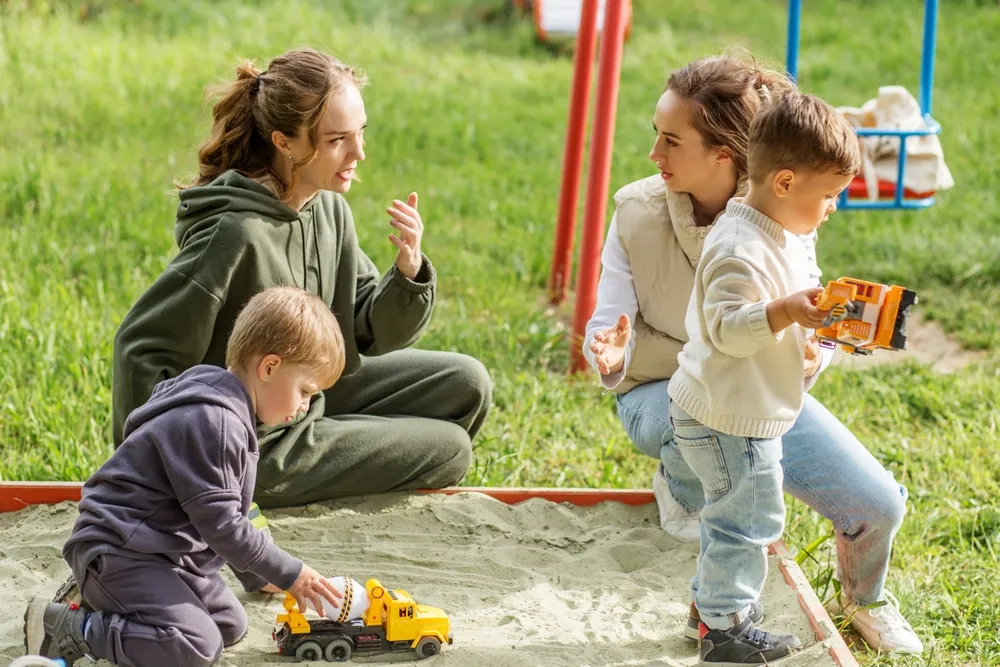
Your toddler watches another child stack blocks. They move closer, pick up a block, and begin building beside them without saying a word. A few minutes later, both children reach for the same piece, and the peaceful moment ends in a loud protest.
Was that successful social play, or does your child need help developing social skills?
For most toddlers, it was both a real social experience and a valuable learning opportunity.
Social skills for toddlers do not begin with perfect sharing, long conversations, or instant friendships. They begin with watching, copying, pointing, responding, playing beside another child, expressing needs, and gradually learning what to do when two people want the same thing.
For Irvine parents, understanding this process can make playdates, daycare transitions, and everyday conflicts feel much less confusing. This guide explains what toddler social development can look like from ages 1 to 3, how parents can encourage it without pressure, and when a concern deserves a conversation with a pediatrician.
Quick answer: The best way to build social skills in toddlers is to provide frequent, low-pressure opportunities to interact while a trusted adult models simple language, names emotions, supports short turns, and helps children recover from conflict. Toddlers learn social skills through relationships, repetition, and play.
Contents
- 1 What Are Social Skills for Toddlers?
- 2 Why Are Social Skills Important in Early Childhood?
- 3 What Social Skills Should a Toddler Have by Age 1, 2, and 3?
- 4 Is Parallel Play Normal for Toddlers?
- 5 Should a 2-Year-Old Know How to Share?
- 6 How Do You Teach Social Skills to Toddlers?
- 6.1 1. Name Feelings Without Judging Them
- 6.2 2. Give Your Toddler Simple Social Phrases
- 6.3 3. Practice Turn-Taking When Everyone Is Calm
- 6.4 4. Let Your Child Watch Before Joining
- 6.5 5. Create Small, Predictable Play Opportunities
- 6.6 6. Describe Positive Social Moments
- 6.7 7. Use Books and Pretend Play
- 6.8 8. Offer Choices During Conflict
- 6.9 9. Keep Daily Routines Predictable
- 6.10 10. Coach Conflict Instead of Silently Solving It
- 6.11 11. Model the Behavior You Want to See
- 6.12 12. Repeat the Skill and Keep Expectations Realistic
- 7 Seven Social Skills Activities for Toddlers
- 8 What Should I Do When My Toddler Hits, Grabs, or Pushes?
- 9 How Can Shy Toddlers Develop Social Confidence?
- 10 Does Daycare Help Toddlers Develop Social Skills?
- 11 Questions to Ask During an Irvine Toddler Daycare Tour
- 12 How DeeCyDa Supports Social-Emotional Development
- 13 When Should Parents Be Concerned About Toddler Social Development?
- 14 Frequently Asked Questions About Social Skills for Toddlers
- 14.1 What are the most important social skills for a 2-year-old?
- 14.2 How can I help my toddler socialize more?
- 14.3 Does my toddler need friends?
- 14.4 Why will my toddler not share toys?
- 14.5 What activities improve toddler communication and social skills?
- 14.6 Is it normal for a toddler to play alone at daycare?
- 14.7 Can educational videos teach toddler social skills?
- 14.8 When should I request a developmental screening?
- 15 Social Confidence Grows One Interaction at a Time
What Are Social Skills for Toddlers?
Social skills are the developing abilities children use to connect with other people, communicate their wants and feelings, participate in routines, and respond to social situations.
During the toddler years, social development is closely connected to language, emotional development, attention, imitation, and self-regulation.
Examples of early social skills include:
- Looking toward a parent or caregiver for reassurance
- Showing an adult something interesting
- Copying another person’s actions
- Playing beside another child
- Joining a simple game
- Using gestures, sounds, or words to request help
- Taking a brief turn with adult support
- Noticing when another person is upset
- Following familiar group routines
- Beginning to identify feelings
- Recovering from frustration with help
The federal Head Start social-emotional development resources describe this area as children’s growing ability to build meaningful relationships, understand and manage emotions, and respond to the emotions of others.
These abilities develop together. A toddler who gains more language, for example, may become better able to say “my turn” or “help me” instead of grabbing a toy.
Why Are Social Skills Important in Early Childhood?
Strong social-emotional skills help toddlers participate in family life, childcare, play, preschool, and other group settings.
These skills support a child’s ability to:
- Communicate needs and boundaries
- Build relationships with trusted adults
- Become comfortable around other children
- Participate in routines and group activities
- Manage strong feelings with adult support
- Solve simple social problems
- Develop empathy and awareness of others
- Build confidence in new environments
- Prepare for preschool and kindergarten
California’s early-learning framework connects social-emotional development with a child’s sense of self, relationships with adults and peers, group participation, cooperation, empathy, and self-regulation.
The California Department of Education’s social-emotional foundations recognize these abilities as interconnected parts of early childhood development.
However, helping toddlers develop social skills does not mean expecting them to behave like preschoolers. The goal is not perfect obedience or polished manners.
The goal is helping children feel secure enough to communicate, participate, explore relationships, and reconnect after something goes wrong.
Social-emotional development is also an important local priority. First 5 Orange County tracks children’s social and emotional development as one measure of whether young children are prepared to succeed.
For parents, the practical message is simple: everyday relationships, responsive caregiving, and high-quality early-learning environments matter.
What Social Skills Should a Toddler Have by Age 1, 2, and 3?
Toddler development follows a general sequence, but it does not follow an identical schedule for every child.
Temperament, communication abilities, family culture, developmental differences, and previous experience around other children can all influence how a toddler behaves socially.
The following examples are based on the CDC’s developmental milestone guidance. The CDC describes milestones as skills that most children, at least 75 percent, can perform by a particular age.
Milestones are helpful guides. They are not tests or diagnoses.
| Approximate age | Social development parents may notice | How adults can help |
| 12 to 15 months | Plays simple social games, shows affection, shows an adult an object, or copies another child’s actions | Respond warmly, copy the child’s actions, and create simple back-and-forth games |
| Around 18 months | Moves away to explore but checks that a caregiver is nearby, points to share interest, or looks at a book with an adult | Follow the child’s point, name what they notice, and remain emotionally available |
| Around 2 years | Notices when someone is hurt or upset and looks at a caregiver’s face to understand a new situation | Name what happened and demonstrate a calm, caring response |
| Around 30 months | Plays next to other children and sometimes interacts with them, follows familiar routines, or proudly shows what they can do | Offer shared materials, predictable routines, and simple language for joining play |
| Around 3 years | Notices other children and joins their play and may settle after a childcare drop-off | Practice joining phrases, prepare for transitions, and maintain a predictable goodbye routine |
Parents can explore the CDC’s complete milestone guidance for 15 months, 18 months, 2 years, 30 months, and 3 years.
Is Parallel Play Normal for Toddlers?
Yes. Parallel play is a normal and valuable stage of toddler social development.
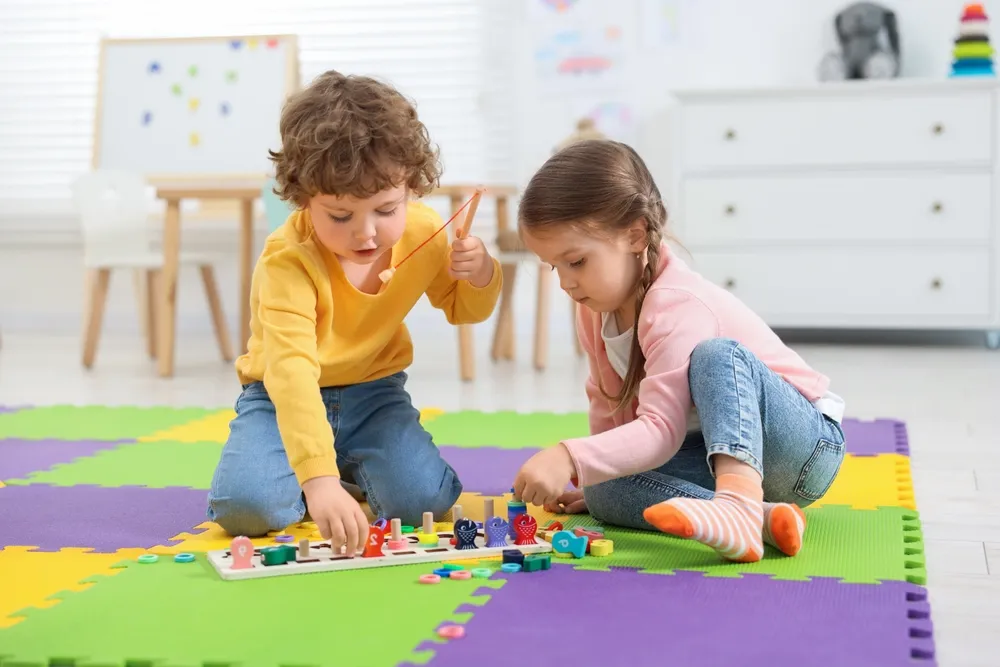
Parallel play happens when children play near one another, often with similar materials, without organizing a shared activity. It may look like separate play to an adult, but the children are still observing, imitating, learning, and becoming comfortable sharing the same space.
By approximately 30 months, the CDC identifies playing next to other children and sometimes playing with them as a common developmental milestone.
Parallel play is not a failed playdate. It is often the bridge between independent play and cooperative play.
Instead of telling toddlers to “play together,” parents can place open-ended or duplicate materials near them. Good options include:
- Building blocks
- Toy animals
- Play food
- Washable art supplies
- Large puzzles
- Cars and trucks
- Balls
- Musical instruments
These materials allow toddlers to watch and copy one another without requiring advanced communication or negotiation.
A 2-year-old can begin practicing sharing, but consistent and independent sharing is usually too much to expect.
A toddler may understand the phrase “take turns” and still become overwhelmed when another child holds a favorite toy.
Sharing requires several developing skills:
- Understanding what another person wants
- Controlling the impulse to grab
- Tolerating a delay
- Trusting that the toy will be returned
- Communicating wants and feelings
- Managing disappointment
Instead of forcing a child to hand over a toy immediately, protect the child’s ongoing play and introduce turn-taking.
For example:
“Maya is using the truck. You can choose the bus while you wait. Then it will be your turn.”
Begin with very short waiting periods. A successful five-second wait is more developmentally helpful than a long wait that ends in distress.
Parents can also put highly valued comfort objects away before playdates. Not every special possession needs to become a sharing lesson.
How Do You Teach Social Skills to Toddlers?
Toddlers learn social behavior most effectively when adults calmly show them what to do in the moment.
Keep your language short, clear, and specific. A toddler experiencing intense frustration cannot process a long explanation.
The following strategies can help parents teach social skills at home, at the park, during playdates, and in childcare.
1. Name Feelings Without Judging Them
Use simple descriptions to help your child connect feelings with language.
“You are mad because the block fell.”
“You wanted another turn.”
“You feel sad that Daddy left.”
Naming a feeling does not reward challenging behavior. It helps the child understand what is happening inside their body.
Parents can acknowledge the emotion while maintaining a boundary:
“It is okay to feel mad. I will not let you hit.”
2. Give Your Toddler Simple Social Phrases
Toddlers often know what they want before they have the words to express it.
Teach one or two short phrases at a time:
- “My turn?”
- “Help, please.”
- “Stop.”
- “Can I play?”
- “All done.”
- “More time.”
- “I want that.”
- “Move, please.”
Gestures and picture cues can support children who are not yet using these words. Communication is meaningful even when it is not spoken.
3. Practice Turn-Taking When Everyone Is Calm
Do not wait for a conflict to introduce turn-taking.
Practice by rolling a ball, adding one block at a time to a tower, placing puzzle pieces, or taking turns making animal sounds.
Say “my turn” and “your turn” so the pattern becomes familiar.
Keep the first waiting periods extremely short. Gradually increase the wait as your child becomes more comfortable.
4. Let Your Child Watch Before Joining
Some toddlers enter a group immediately. Others need time to stand nearby, hold a caregiver’s hand, and observe.
Watching may be how a cautious child gathers information and becomes comfortable.
Describe what is happening without pressure:
“The children are rolling balls. We can watch. You can join when you are ready.”
A child who watches quietly may still be socially engaged.
5. Create Small, Predictable Play Opportunities
A crowded birthday party may be too demanding for a toddler who is beginning to socialize.
Start with one familiar child, a comfortable environment, and a short period of play. Simple activities with a clear purpose usually work better than expecting toddlers to entertain one another.
End the playdate while the children still have energy. Waiting until both children are hungry, tired, or overstimulated makes conflict more likely.
6. Describe Positive Social Moments
Notice and describe helpful behavior when it happens.
“You gave Sam a block. Now you are building together.”
“You waited while I poured the water.”
“You used gentle hands with the baby.”
“You asked for help instead of grabbing.”
Specific feedback teaches more than a general “good job” because it tells the child which behavior was successful.
7. Use Books and Pretend Play
Books can help toddlers notice facial expressions, feelings, and social situations.
Pause while reading and ask:
“How does she feel?”
“What could he do?”
“Who might help?”
Avoid turning reading into a test. If your child does not answer, offer the language yourself.
Dolls, stuffed animals, and puppets can also practice greeting, asking for a turn, waiting, helping, and calming down.
Pretend play is especially helpful before daycare, a playdate, a doctor’s appointment, or meeting a new caregiver.
8. Offer Choices During Conflict
When possible, give your toddler two acceptable options:
“You can wait beside me or play with the blue truck.”
“You can ask for a turn or choose another shovel.”
“You can stomp your feet or squeeze this pillow. I will not let you hit.”
Choices give children a small sense of control while keeping the safety boundary clear.
Avoid asking a question when “no” is not a real option. Instead of asking, “Can you stop hitting?” say, “I will not let you hit.”
9. Keep Daily Routines Predictable
Children are more available for social learning when they understand what will happen next.
Use consistent routines for:
- Morning arrival
- Cleaning up
- Washing hands
- Snack time
- Rest
- Outdoor play
- Leaving the park
- Bedtime
First 5 Orange County’s guidance on schedules and transitions explains that structured routines support multiple areas of development and can reduce frustration caused by uncertainty.
Give short transition warnings:
“Two more turns, then we clean up.”
For younger toddlers, pair the words with a picture, gesture, or familiar clean-up song.
10. Coach Conflict Instead of Silently Solving It
When two toddlers have a conflict, move close and protect everyone’s safety.
Describe the problem:
“Two children want one shovel.”
Then model a manageable solution. One child might wait with adult support, choose another tool, or find a way to use the item together.
Avoid requiring an immediate apology from a highly upset toddler. First help the children become calm and safe.
Repair can happen afterward through a simple action:
- Returning an item
- Helping rebuild a tower
- Getting a tissue
- Checking on the other child
- Trying the interaction again gently
11. Model the Behavior You Want to See
Toddlers closely observe adults.
Let your child hear you:
- Greet people
- Ask permission
- Wait for a turn
- Thank someone
- State a boundary respectfully
- Acknowledge a mistake
- Apologize and reconnect
If you raise your voice, model repair:
“I used a loud voice. That felt scary. I am calm now, and I am sorry.”
This teaches children that relationships can recover after difficult moments.
12. Repeat the Skill and Keep Expectations Realistic
A toddler may use a new social skill at home but not at daycare. They may use words with a parent but grab when interacting with another child.
That does not mean the lesson failed.
Social skills become reliable through repetition across different people, places, and emotional situations.
If an activity repeatedly causes distress, make it shorter, reduce the number of children, simplify the language, or try again when your child is rested and comfortable.
Seven Social Skills Activities for Toddlers
Activities for toddler social development do not require complicated materials. The most effective games create a simple back-and-forth pattern and allow the child to communicate.
| Activity | Social skill practiced | How to play |
| Roll-and-return ball game | Joint attention and turn-taking | Sit close, roll the ball, and say “your turn” and “my turn” |
| Build one shared tower | Waiting, imitation, and cooperation | Each person adds one block before passing the container |
| Puppet feelings | Emotion recognition and problem-solving | Let a puppet feel sad, angry, or nervous and model a helpful response |
| Pretend snack or tea | Requests and reciprocal play | Practice offering, accepting, saying “more,” and saying “all done” |
| Copy-my-movement song | Imitation and group attention | Take turns choosing a clap, stomp, wiggle, or spin |
| Helper partnership | Cooperation and routines | Carry napkins, match socks, water a plant, or put toys into a basket together |
| Family photo feelings | Reading facial expressions | Look at familiar photos and talk about what people may be feeling |
Parents looking for additional play-based ideas can explore DeeCyDa’s guide to learning activities for toddlers ages 1 to 3.
What Should I Do When My Toddler Hits, Grabs, or Pushes?
Start with safety, not shame.
Move close, block the unsafe action if necessary, and use a calm statement:
“I will not let you hit.”
Attend to anyone who was hurt. Then help your toddler communicate the need behind the behavior.
A helpful four-step response is:
- Stop the unsafe behavior: “I will not let you push.”
- Name the likely problem: “You wanted the truck.”
- Model an alternative: “Say, ‘turn, please,’ or ask me for help.”
- Support repair after the child is calm.
Hitting, grabbing, and pushing may happen when a toddler experiences a strong feeling but does not yet have enough language or impulse control to manage it.
Look for patterns. Common triggers may include:
- Hunger
- Fatigue
- Crowded environments
- Abrupt transitions
- Competition over one toy
- Difficulty communicating
- Overstimulation
- Playdates that last too long
If aggressive behavior is frequent, intense, causes injuries, happens across several settings, or concerns you, discuss specific examples with your child’s pediatrician.
How Can Shy Toddlers Develop Social Confidence?
A quiet or slow-to-warm toddler is not necessarily missing social skills.
Some children need more time to feel safe around unfamiliar people and environments. Support them by arriving early, explaining what will happen, staying nearby initially, and allowing them to observe.
Give your child a simple way to enter the activity, such as carrying two balls into the play area or choosing a book for storytime.
Avoid repeatedly labeling your child as shy. Instead, say:
“She likes to watch before she joins.”
This describes the current behavior without turning it into a permanent identity.
Progress may look like:
- Standing closer to the group
- Watching another child
- Copying a movement
- Making eye contact
- Handing another child an object
- Joining for one minute
- Staying after the parent moves slightly farther away
Social connection does not always begin with conversation.
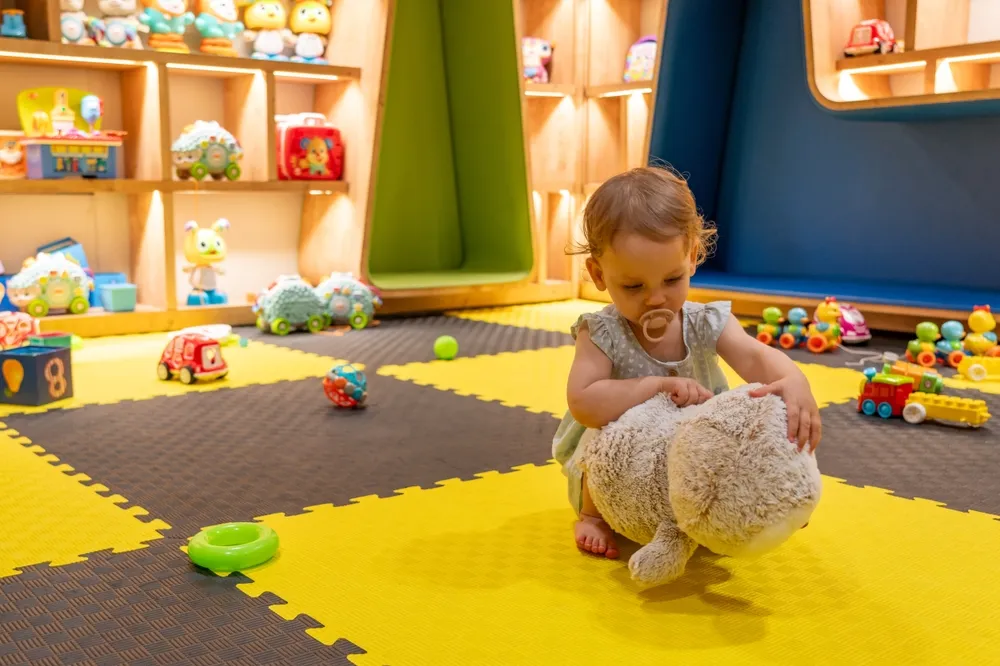
Does Daycare Help Toddlers Develop Social Skills?
A thoughtfully designed toddler program can provide regular opportunities to observe peers, participate in routines, communicate needs, and receive guidance from familiar caregivers.
However, simply placing several toddlers in one room does not automatically teach social skills. The quality of adult-child interaction matters.
Look for caregivers who:
- Get down to the child’s level
- Notice verbal and nonverbal cues
- Respond calmly to strong emotions
- Model simple social language
- Protect children’s safety without shaming them
- Support short turns
- Respect children who need time to observe
- Communicate with parents about patterns and progress
The Head Start guidance for infant and toddler care identifies responsive and nurturing relationships as a central part of social-emotional development.
DeeCyDa’s Caterpillar toddler program in Irvine serves children ages 1 to 2.9. The program combines storytime, music, pretend play, building, sensory experiences, indoor and outdoor activities, and opportunities for children to interact with their peers.
Families comparing toddler care can also read DeeCyDa’s complete Toddler Development Program in Irvine guide.
Questions to Ask During an Irvine Toddler Daycare Tour
Parents should look beyond toys, decorations, and general claims about socialization.
Ask caregivers:
- How do you respond when two toddlers want the same toy?
- Are children forced to share or helped through short turns?
- How do you respond to hitting, biting, pushing, or grabbing?
- How do you help children identify their feelings?
- What support is available for children who watch before joining?
- How do you handle morning drop-off?
- How are transitions communicated to toddlers?
- How do teachers share social progress with parents?
- Are activities adjusted for different communication abilities?
- How much time do toddlers receive for free and guided play?
Irvine families near Quail Hill, Turtle Rock, and University Park can also use DeeCyDa’s local daycare comparison guide when evaluating location, program quality, routines, and teacher-child interaction.
Image:
How DeeCyDa Supports Social-Emotional Development
At DeeCyDa Child Care & Learning Center, toddler social development is part of the broader goal of helping young children become secure, expressive, considerate, and increasingly independent.
Broad values become age-appropriate daily experiences. Children can practice greeting others, joining routines, communicating needs, making simple choices, helping with shared tasks, and trying again after frustration.
Mahshid Hosseini’s DeeCyDa profile describes her focus on early childhood development, education, leadership, coaching, etiquette, positive thinking, self-motivation, and gratitude.
As DeeCyDa’s owner and head coach, her perspective supports a whole-child approach in which children build social skills through relationships, respectful communication, and repeated practice.
For toddlers, progress often appears in small moments.
A child who looks to a teacher for help instead of pushing has made progress. So has the child who stays beside a peer, waits for one short turn, uses a gesture to say “stop,” or reconnects after becoming upset.
When Should Parents Be Concerned About Toddler Social Development?
Children develop at different rates, and one difficult playdate is not a developmental assessment.
However, parents should raise concerns instead of waiting until they feel completely certain.
Speak with your child’s pediatrician if:
- Your child is not meeting one or more expected milestones
- Your child has lost a skill they previously used
- Your child rarely responds to social interaction
- Your child does not use gestures, sounds, or words to communicate needs
- Social situations regularly cause significant distress
- Aggressive behavior is frequent or causes injuries
- You have concerns about how your child plays, communicates, behaves, or connects
The CDC recommends acting early when a child is not meeting milestones, has lost skills, or when a parent has other developmental concerns.
For children under age 3, California’s Early Start program provides early-intervention pathways for eligible infants and toddlers with developmental delays or established risk conditions.
Requesting information or an evaluation does not label a child. It helps families understand whether additional support may be useful.
Milestone lists cannot represent every child’s development, disability, culture, language background, or communication style. Use them to guide conversations with qualified professionals, not to diagnose or compare children at home.
Frequently Asked Questions About Social Skills for Toddlers
Important emerging skills include noticing other people’s emotions, looking to a trusted adult during unfamiliar situations, communicating needs, copying actions, playing near other children, and practicing short turns with help. Perfect sharing and independent conflict resolution are not realistic expectations for every 2-year-old.
Provide short and predictable interactions with one or two children. Let your toddler observe before joining and offer simple activities such as ball rolling, building blocks, music, or pretend play. Stay nearby to model language and support conflict.
Does my toddler need friends?
Toddlers benefit from warm relationships and opportunities to be around other children. However, toddler friendship does not need to resemble an older child’s friendship. Familiarity, imitation, parallel play, greeting a peer, and enjoying a repeated game are meaningful early forms of connection.
Sharing requires impulse control, language, patience, and awareness of another person’s perspective. These abilities are still developing during toddlerhood. Practice short turns, provide duplicate materials, and put especially important comfort objects away during group play.
Back-and-forth games are particularly helpful. Try rolling a ball, building one tower together, singing action songs, using puppets to explore feelings, preparing pretend meals, completing simple helper tasks, and reading books about emotions.
Is it normal for a toddler to play alone at daycare?
It can be. Toddlers often move between solitary play, observation, parallel play, and brief interactions. Ask the caregiver what happens throughout the day instead of evaluating one moment at drop-off.
A video may introduce a song, story, or feeling word, but it cannot replace responsive interaction. Toddlers practice social skills through real conversations, facial expressions, gestures, movement, shared attention, and relationships.
When should I request a developmental screening?
Ask whenever you have a concern, when your child is not meeting one or more milestones, or when your child has lost a skill they previously used. Parents do not need to wait for the next birthday or for a concern to become severe.
Social Confidence Grows One Interaction at a Time
Toddlers do not become socially confident because an adult repeatedly tells them to share.
They grow through hundreds of ordinary interactions. A caregiver responds to a point. Another child copies their dance. A teacher helps them wait for a shovel. A parent gives them the words they could not find while upset.
Instead of asking, “Is my toddler social enough?” consider asking:
“What small social skill is my child practicing now, and how can I help them take the next step?”
If you are exploring toddler care in Irvine, contact DeeCyDa to schedule a visit and discover how the Caterpillar Program supports play, communication, routines, confidence, and early social connection.