

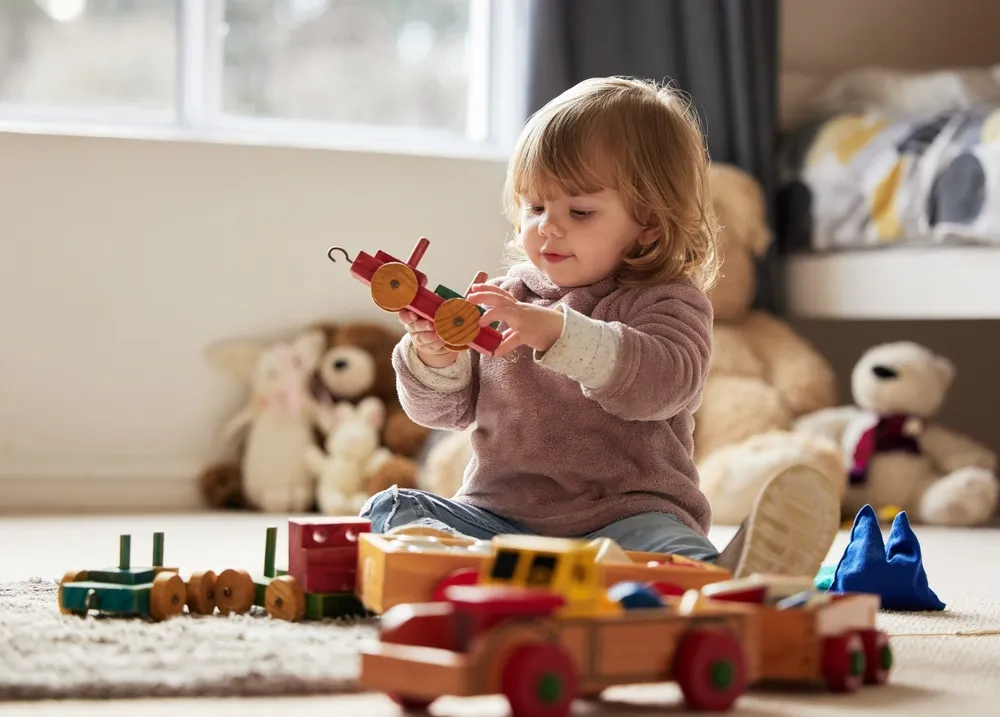
The best learning activities for toddlers are simple experiences that combine movement, language, sensory exploration, problem-solving, creativity, and interaction. Reading together, building with blocks, pretending, singing, sorting, rolling a ball, exploring outdoors, and supervised sensory play can all create meaningful learning opportunities.
For Irvine parents, the reassuring part is that toddler learning does not require expensive toys, worksheets, or elaborate projects. Ordinary play becomes educational when an adult notices what a child is interested in, talks about it, responds, models new ideas, and gives the child time to explore.
Contents
- 1 Key Takeaways
- 2 How Toddlers Learn Through Play
- 3 Choosing the Right Activity for Your Toddler’s Age
- 4 15 Best Learning Activities for Toddlers
- 4.1 1. Picture-Book Naming and Pointing
- 4.2 2. Block Stacking and Simple Building
- 4.3 3. Safe Color and Shape Sorting
- 4.4 4. Music, Clapping, and Action Songs
- 4.5 5. Pretend Kitchen or Caregiving Play
- 4.6 6. Supervised Water Pouring
- 4.7 7. Taste-Safe Sensory Exploration
- 4.8 8. Large-Piece Puzzles and Matching
- 4.9 9. Scribbling and Washable Art
- 4.10 10. Indoor Movement Course
- 4.11 11. Ball Rolling, Throwing, and Kicking
- 4.12 12. Nature Walk and Outdoor Discovery
- 4.13 13. Cardboard Box Imagination Play
- 4.14 14. Helping With Simple Daily Tasks
- 4.15 15. Emotion Faces and Simple Social Play
- 4.16 Quick Reference: Toddler Learning Activities
- 5 How to Turn Ordinary Play Into a Learning Experience
- 6 How Long Should a Toddler Learning Activity Last?
- 7 Common Mistakes to Avoid During Toddler Play
- 8 Learning at Home vs. Learning in a Toddler Program
- 9 How DeeCyDa Supports Learning Through Play in Irvine
- 10 Frequently Asked Questions
- 10.1 1. What are the best learning activities for a 1-year-old?
- 10.2 2. What are the best learning activities for a 2-year-old?
- 10.3 3. How can I teach my toddler through play?
- 10.4 4. How long should a toddler play with one activity?
- 10.5 5. Are sensory activities safe for toddlers?
- 10.6 6. What indoor activities help toddlers learn?
- 10.7 7. How does pretend play help toddler development?
- 10.8 8. Do toddlers need educational toys to learn?
- 10.9 9. How much adult direction should toddler play include?
- 10.10 10. What should I look for in a play-based toddler program in Irvine?
- 10.11 11. When should I speak with a pediatrician about development?
- 11 Start With Simple, Responsive Play
Key Takeaways
- Toddlers learn through play, repetition, movement, imitation, and conversation.
- Simple materials often offer more possibilities than complicated toys.
- Repeating a favorite book, song, or activity can be valuable.
- Children develop at different rates, so follow abilities and interests rather than rigid expectations.
- Responsive interaction with a parent or caregiver often matters more than the activity itself.
How Toddlers Learn Through Play
Learning through play means children build skills by actively exploring, moving, communicating, experimenting, imagining, and interacting with other people.
A toddler stacking the same two blocks again and again is experimenting with balance. A child repeatedly asking for the same book is connecting sounds, pictures, words, and predictable sequences. A toddler pretending to feed a stuffed animal is practicing imitation and beginning pretend play.
The American Academy of Pediatrics’ Power of Play explains that play contributes to social-emotional, cognitive, language, and self-regulation development while supporting nurturing relationships.
Toddlers commonly learn through:
- Repetition
- Imitating adults and other children
- Physical movement
- Trial and error
- Sensory exploration
- Conversation
- Pretend play
- Interaction with trusted adults and peers
These experiences may create opportunities to practice language and communication, fine and gross motor coordination, problem-solving, social participation, independence, creativity, and emotional regulation.
The CDC’s developmental guidance for 2-year-olds, for example, includes pointing to pictures in books, combining toys during play, kicking a ball, running, helping with simple tasks, working with puzzles, singing, drawing, and building with blocks.
Developmental milestones are useful guides, not strict deadlines or individual assessments. Children develop at different rates.
Choosing the Right Activity for Your Toddler’s Age
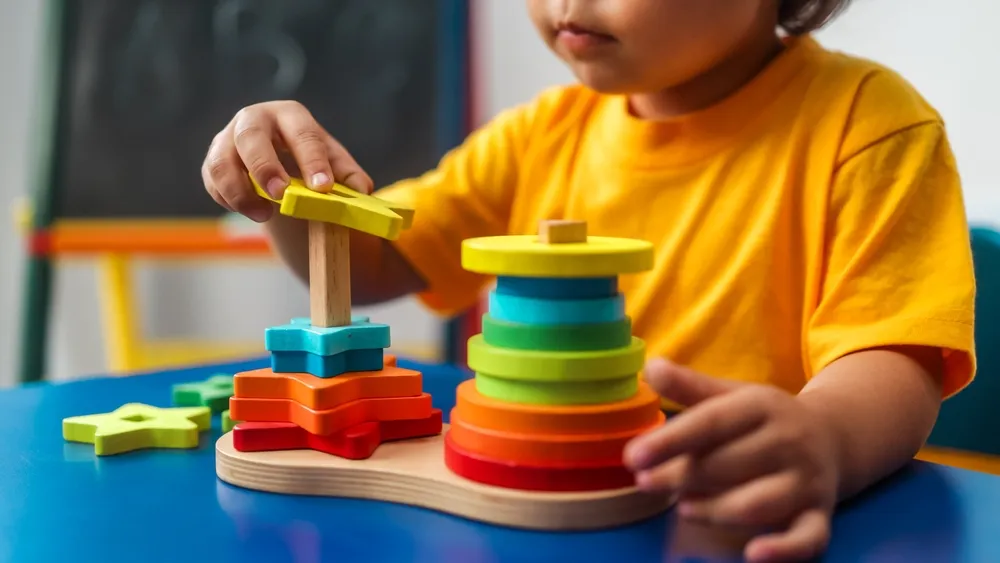
Age ranges are approximate. Choose activities based on what your toddler can safely manage, enjoy exploring, and are ready to practice.
| Approximate age | What play may look like | Helpful activity types | Adult’s role | Important safety consideration |
| 12-18 months | Exploring through touching, carrying, dropping, filling, emptying, moving, and imitation | Board books, large blocks, music, balls, simple containers | Name actions, model one step, repeat words, supervise closely | Avoid small objects and unstable climbing surfaces |
| 18-24 months | More purposeful imitation, simple pretend play, experimenting, sorting, and repeated actions | Pretend play, simple puzzles, pouring, scribbling, movement | Follow interests, offer choices, model language | Assume materials may still go into the mouth |
| 24-35 months | Longer pretend sequences, emerging peer interest, matching, movement games, and helping with routines | Pretend play, matching, art, simple chores, outdoor exploration | Expand language, model turn-taking, introduce simple challenges | Match materials and equipment to the child’s actual abilities |
The CDC’s age-3 milestone guidance also emphasizes conversation, play with other children, matching, songs, drawing, outdoor play, pretend play, and simple participation in everyday tasks.
15 Best Learning Activities for Toddlers
1. Picture-Book Naming and Pointing
Best age: 12-35 months
Materials: Sturdy board books or a family photo book
How: Let your toddler turn pages and point. Name familiar people, animals, objects, and actions.
May support: Language, listening, joint attention, memory
Extend it: Pause before familiar words or ask, “Where is the dog?”
Easier: Simply name what your child touches.
More challenging: Ask simple “what” or “where” questions.
Safety: Use sturdy, age-appropriate books.
Reading the same book repeatedly is not wasted time. Predictability gives toddlers another opportunity to notice words, pictures, sounds, and sequences.
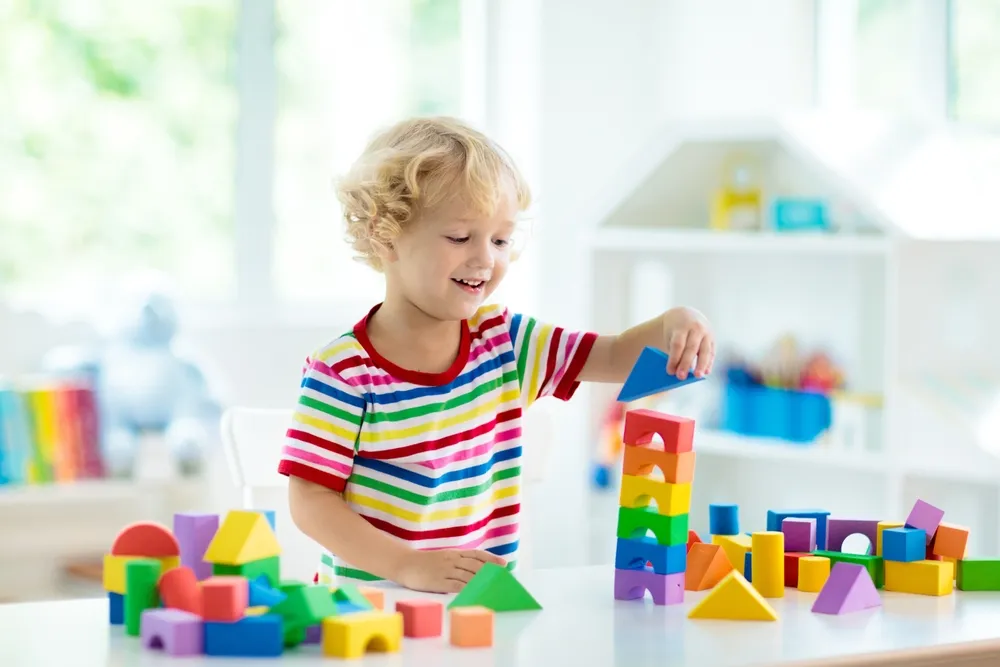
2. Block Stacking and Simple Building
Best age: 12-35 months
Materials: Large toddler-safe blocks
How: Stack, knock down, rebuild, and place blocks beside or under one another.
May support: Fine motor control, coordination, problem-solving, spatial language
Extend it: Say, “The block is on top,” or “Let’s build up.”
Easier: Stack two large blocks.
More challenging: Copy a short structure or sort large blocks.
Safety: Choose pieces too large to become choking hazards.
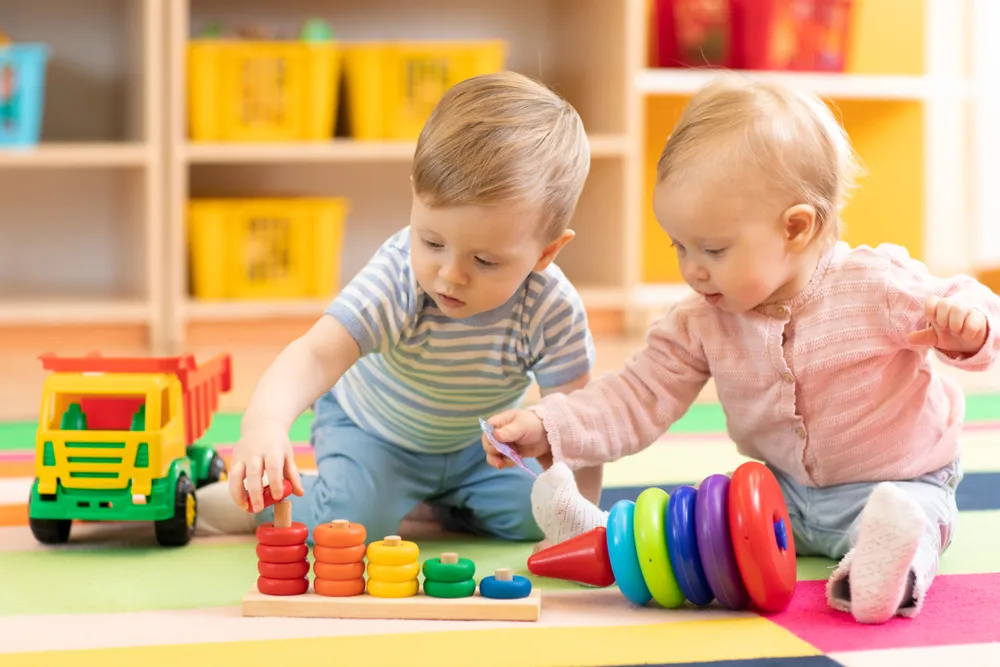
3. Safe Color and Shape Sorting
Best age: 18-35 months
Materials: Large safe objects in a few colors or shapes
How: Group objects that look alike. Matching matters more than naming every color correctly.
May support: Visual comparison, early categorization, problem-solving
Extend it: Narrate, “These two match.”
Easier: Offer two clearly different groups.
More challenging: Sort by a second characteristic.
Safety: Avoid buttons, beads, counters, or other small sorting pieces.
4. Music, Clapping, and Action Songs
Best age: 12-35 months
Materials: Your voice, music, optional toddler-safe instruments
How: Clap, stomp, sway, copy movements, and practice stopping and starting.
May support: Listening, language, coordination, imitation, memory
Extend it: Pause during a familiar song and see whether your toddler responds.
Easier: Copy one simple motion.
More challenging: Alternate loud/quiet or fast/slow movements.
Safety: Keep volume comfortable and instruments age-appropriate.
5. Pretend Kitchen or Caregiving Play
Best age: 18-35 months
Materials: Dolls, stuffed animals, large toy food, or safe household objects
How: Pretend to cook, feed a doll, wash a toy, or put a stuffed animal to bed.
May support: Language, sequencing, imagination, imitation, social-emotional learning
Extend it: Introduce words like stir, hungry, sleepy, wash, and more.
Easier: Model one familiar action.
More challenging: Create a two-step pretend routine.
Safety: Remove small accessories.
6. Supervised Water Pouring
Best age: 18-35 months
Materials: Shallow container, cups, scoops, funnels
How: Let your toddler fill, pour, scoop, and empty.
May support: Hand-eye coordination, cause and effect, comparison, vocabulary
Extend it: Say, “The cup is full. Now it is empty.”
Easier: Transfer water between two wide containers.
More challenging: Add different container shapes.
Safety: Provide close, continuous adult supervision and empty containers immediately afterward. Never leave a toddler alone around standing water.
7. Taste-Safe Sensory Exploration
Best age: 12-35 months, depending on readiness
Materials: Developmentally appropriate, taste-safe materials and large objects
How: Invite touching, squeezing, spreading, scooping, or noticing temperature and texture.
May support: Sensory exploration, vocabulary, hand use, curiosity
Extend it: Use words such as soft, cool, sticky, smooth, and wet.
Easier: Explore one texture.
More challenging: Compare two safe textures.
Safety: Avoid small loose fillers such as dry rice, beads, water beads, and small pasta for young toddlers. Supervise continuously.
8. Large-Piece Puzzles and Matching
Best age: 18-35 months
Materials: Simple inset puzzle or pairs of familiar objects
How: Let your toddler experiment with where pieces fit.
May support: Visual matching, fine motor control, persistence, problem-solving
Extend it: Name the picture when the child handles it.
Easier: Remove most pieces and offer one choice.
More challenging: Match familiar household objects or pictures.
Safety: Use large, intact puzzle pieces.
Avoid correcting every attempt. Trying, rotating, removing, and trying again are part of the activity.
9. Scribbling and Washable Art
Best age: 15-35 months
Materials: Large age-appropriate crayons, paper, washable non-toxic art materials
How: Let your toddler make lines, dots, and marks without requiring a recognizable picture.
May support: Hand control, creativity, early mark-making, choice-making
Extend it: Describe rather than judge: “You made a long line.”
Easier: Use one large crayon.
More challenging: Offer two colors.
Safety: Use age-appropriate supplies and supervise to discourage mouthing.
10. Indoor Movement Course
Best age: 18-35 months
Materials: Stable cushions, taped floor lines, safe tunnels, low stepping points
How: Create a simple route for walking, crawling, stepping, or moving around objects.
May support: Balance, gross motor coordination, body awareness, listening
Extend it: Add words like over, around, through, slow, and stop.
Easier: Use one obstacle.
More challenging: Create a short sequence.
Safety: Avoid unstable furniture, elevated climbing, sharp corners, or slippery surfaces.
11. Ball Rolling, Throwing, and Kicking
Best age: 12-35 months
Materials: Soft, toddler-sized ball
How: Roll a ball back and forth, kick it toward a target, or practice gentle throwing.
May support: Coordination, visual tracking, gross motor skills, turn-taking
Extend it: Say, “Ready, set, roll,” or give one-step directions.
Easier: Roll while sitting.
More challenging: Kick toward a large target.
Safety: Provide enough open space for movement.
12. Nature Walk and Outdoor Discovery
Best age: 12-35 months
Materials: Safe outdoor space
How: Walk slowly and notice trees, shadows, birds, sounds, textures, and movement.
May support: Vocabulary, observation, movement, curiosity, sensory awareness
Extend it: Follow your child’s attention: “You heard a bird.”
Easier: Explore one small area.
More challenging: Look for two things that are alike.
Safety: Closely supervise and collect only large, safe natural items that will not be mouthed.
13. Cardboard Box Imagination Play
Best age: 18-35 months
Materials: Large clean cardboard box
How: Let the box become a car, house, tunnel, bed, bus, or pretend store.
May support: Imagination, flexible thinking, movement, language
Extend it: Follow the toddler’s idea instead of deciding what the box must become.
Easier: Crawl in and out.
More challenging: Add a simple pretend sequence.
Safety: Remove staples, tape loops, sharp edges, and damaged cardboard.
14. Helping With Simple Daily Tasks
Best age: 18-35 months
Materials: Ordinary household items
How: Invite your toddler to put laundry in a basket, wipe a safe surface, carry an unbreakable cup, sort socks, or put toys away.
May support: Independence, sequencing, language, coordination, belonging
Extend it: Narrate each step and thank the child for participating.
Easier: Give one object to put away.
More challenging: Complete two related steps.
Safety: Keep cleaners, breakables, hot objects, and sharp tools inaccessible.
15. Emotion Faces and Simple Social Play
Best age: 18-35 months
Materials: Books, mirror, dolls, or family photographs
How: Notice facial expressions, imitate simple faces, roll a ball back and forth, or practice short turns.
May support: Emotional vocabulary, imitation, attention to others, early social participation
Extend it: Say, “She looks sad,” without insisting that your toddler label the emotion.
Easier: Copy a smile or surprised face.
More challenging: Connect an emotion to a simple story.
Safety: Keep interaction playful. Do not pressure a toddler to perform or disclose feelings.
Quick Reference: Toddler Learning Activities
| Activity | Main developmental focus | Setting | Preparation | Suggested age |
| Picture books | Language | Indoor | Low | 12-35 months |
| Blocks | Fine motor/problem-solving | Indoor | Low | 12-35 months |
| Sorting | Cognitive | Indoor | Low | 18-35 months |
| Music | Language/movement | Either | Low | 12-35 months |
| Pretend play | Language/social | Indoor | Low | 18-35 months |
| Water pouring | Fine motor/sensory | Either | Medium | 18-35 months |
| Sensory exploration | Sensory/language | Either | Medium | 12-35 months |
| Puzzles | Cognitive/fine motor | Indoor | Low | 18-35 months |
| Scribbling | Fine motor/creativity | Indoor | Low | 15-35 months |
| Movement course | Gross motor | Indoor | Medium | 18-35 months |
| Ball play | Gross motor/social | Either | Low | 12-35 months |
| Nature walk | Language/exploration | Outdoor | Low | 12-35 months |
| Cardboard box | Imagination | Indoor | Low | 18-35 months |
| Simple tasks | Independence | Indoor | Low | 18-35 months |
| Emotion/social play | Social-emotional | Indoor | Low | 18-35 months |
How to Turn Ordinary Play Into a Learning Experience
You do not need to convert play into a lesson. Instead, join your toddler’s attention and add just enough language or modeling to help extend the experience.
Try these techniques:
- Narrate what your child is doing.
- Ask simple questions your toddler can reasonably answer.
- Pause and give time for a gesture, sound, word, or action.
- Repeat useful words.
- Follow your child’s interest.
- Model one new action at a time.
- Offer two manageable choices.
- Avoid correcting every unsuccessful attempt.
- End or change the activity when frustration becomes overwhelming.
- Make cleanup part of the routine.
Natural phrases might include:
- “You put the blue block on top.”
- “The cup is full. Now it is empty.”
- “The ball rolled under the chair.”
- “Would you like the red crayon or the yellow crayon?”
Parents looking for more age-specific ideas can also read DeeCyDa’s toddler development program in Irvine parent guide.
How Long Should a Toddler Learning Activity Last?
There is no universal ideal length for a toddler activity. A toddler may explore something for several minutes, leave, and return later. That can still be meaningful play.
Attention varies with age, temperament, interest, hunger, sleep, environment, and developmental readiness. Instead of expecting a toddler to “finish,” watch for signs that interest is fading.
A short activity that follows a child’s curiosity can be more appropriate than a longer activity kept going through repeated adult prompting.
Common Mistakes to Avoid During Toddler Play
Parents do not need to make every moment educational. Useful toddler play usually leaves room for experimentation.
Try to avoid:
- Expecting a polished finished product
- Giving several instructions at once
- Turning conversation into constant testing
- Comparing one child’s skills with another’s
- Assuming expensive educational toys are necessary
- Providing materials that create choking hazards
- Leaving toddlers near water without continuous supervision
- Turning every activity into formal teaching
- Expecting long periods of concentration
- Relying on screens as the main form of learning
- Assuming an activity is valuable simply because it is messy
The CDC’s positive parenting guidance for toddlers ages 2-3 emphasizes reading, pretend play, outdoor exploration, songs, free play, and close attention to safety, including water and choking risks.
Learning at Home vs. Learning in a Toddler Program
Learning at home and learning in a toddler program can complement each other.
| At home | A high-quality toddler program may add |
| Familiar environment | Consistent group routines |
| Parent-child bonding | Regular peer interaction |
| Flexible timing | Guided small-group experiences |
| One-on-one attention | Different play stations and materials |
| Family routines and culture | Opportunities to practice transitions |
| Activities based on immediate interests | Indoor and outdoor movement experiences |
| Everyday language interaction | Ongoing language-rich conversations with caregivers |
Home learning is not inadequate because a child attends daycare, and daycare does not replace what children learn through their families.
For working parents in Irvine, a thoughtfully designed toddler program can provide another consistent environment where children have opportunities to move, explore, communicate, play alongside peers, and build familiarity with routines.
Families comparing options can learn more about DeeCyDa’s approach to childcare and early learning in Irvine.
How DeeCyDa Supports Learning Through Play in Irvine
DeeCyDa Child Care & Learning Center is located in Irvine, California. Its play-based Caterpillar Program serves toddlers from ages 1 to 2.9 years.
Learning experiences may include storytime, music and movement, sensory exploration, building activities, pretend play, indoor and outdoor play, language-rich interaction, and opportunities to engage with peers.
Within a responsive toddler environment, caregivers can adjust the level of guidance according to children’s interests, comfort, and emerging abilities. The broader purpose is to create age-appropriate opportunities for communication, curiosity, confidence, independence, and participation with others without expecting every toddler to learn in exactly the same way.
DeeCyDa leadership insight:
“Toddlers learn best when they feel secure enough to explore, make choices, repeat experiences, and try things in their own way. At DeeCyDa, our role is not to rush children toward a result, but to create a safe, thoughtful environment where educators observe closely, respond to each child’s interests, and gently introduce the next opportunity for language, movement, problem-solving, and social connection. In these early years, meaningful learning often happens in very simple moments: building a tower, sharing a book, moving to music, or learning how to participate alongside another child.”
Mahshid Hosseini
Owner & Head Coach, DeeCyDa Child Care & Learning Center, Irvine
Families who want to see the setting before making a decision can explore DeeCyDa’s learning environment.
If you are exploring toddler care in Irvine, schedule a visit to see how DeeCyDa’s Caterpillar Program approaches learning through play.
Frequently Asked Questions
1. What are the best learning activities for a 1-year-old?
The best activities for many 1-year-olds involve movement, imitation, simple language, and safe hands-on exploration. Try board books, large blocks, music, rolling a ball, filling and emptying containers, simple movement games, and walks outdoors. Follow your child’s current abilities rather than expecting a specific performance. Materials should be large, sturdy, age-appropriate, and closely supervised because young toddlers frequently explore objects with their mouths.
2. What are the best learning activities for a 2-year-old?
Good learning activities for 2-year-olds include pretend play, blocks, simple puzzles, scribbling, music, ball play, sorting large objects, helping with everyday tasks, books, and outdoor exploration. These experiences can create opportunities to practice language, coordination, problem-solving, independence, and social participation. The goal is exploration and interaction rather than completing an academic lesson.
3. How can I teach my toddler through play?
Teach through play by joining what your toddler is already doing and adding language, choices, or one manageable challenge. If your toddler stacks blocks, describe “up” and “down.” If your child pours water, talk about “full” and “empty.” Respond to gestures and words, pause for answers, model an action, and then let your child experiment rather than directing every step.
4. How long should a toddler play with one activity?
There is no required amount of time a toddler should stay with one activity. A few focused minutes can be worthwhile, especially for younger toddlers. Interest may change according to sleep, hunger, temperament, distractions, and developmental readiness. Instead of requiring completion, watch your toddler’s cues and stop, simplify, or move to something else when interest has clearly ended.
5. Are sensory activities safe for toddlers?
Sensory activities can be appropriate when the materials match the toddler’s age and abilities and an adult supervises closely. Young toddlers may mouth materials, so avoid small loose objects and other items that could be swallowed or become choking hazards. Water requires continuous supervision. “Taste-safe” does not mean unsupervised, and mess alone does not make an activity developmentally useful.
6. What indoor activities help toddlers learn?
Useful indoor toddler activities include reading, block building, music and dancing, simple puzzles, pretend play, scribbling, cardboard-box play, sorting large safe objects, and low movement courses. Everyday routines can also become learning experiences. Putting toys in a basket or carrying an unbreakable cup gives a toddler opportunities to listen, move, participate, and practice independence.
7. How does pretend play help toddler development?
Pretend play gives toddlers opportunities to imitate familiar experiences, use language, practice sequences, and explore social ideas. A toddler might pretend to feed a doll, make food, answer a pretend phone, or put a stuffed animal to sleep. Adults can extend the activity with simple vocabulary and modeling while allowing the child to decide where the play goes next.
8. Do toddlers need educational toys to learn?
No. Toddlers can learn with simple, open-ended materials and ordinary household experiences. Blocks, balls, books, cardboard boxes, safe containers, songs, outdoor walks, and pretend play provide many opportunities for exploration. What an attentive adult says and does during play can be more meaningful than whether a product is marketed as “educational.”
9. How much adult direction should toddler play include?
Toddler play usually benefits from a balance of adult support and child choice. Adults can maintain safety, introduce materials, model one action, add useful words, or help when frustration becomes too high. Then give the toddler time to experiment. Constant correction or questioning can turn exploration into a performance instead of allowing the child to investigate.
10. What should I look for in a play-based toddler program in Irvine?
Look for responsive caregivers, appropriate supervision, predictable routines, safe spaces for movement, books, music, open-ended play, language-rich interaction, indoor and outdoor experiences, and realistic expectations for toddler behavior. During an Irvine toddler daycare tour, observe how adults respond to children’s communication, emotions, curiosity, and transitions. Ask how activities are adjusted for different interests and abilities.
11. When should I speak with a pediatrician about development?
Speak with your child’s pediatrician or another qualified health professional whenever you have concerns about development, notice a loss of previously used skills, or have questions about developmental milestones. Developmental information in this article is general education, not an individual assessment or diagnosis. The CDC also recommends discussing concerns with a child’s doctor and asking about developmental screening when appropriate.
Start With Simple, Responsive Play
Parents do not need to recreate a classroom at home.
A board book can become a conversation. A ball can become a turn-taking game. A cardboard box can become a bus. A song can lead to movement and new words. A walk can become an opportunity to notice sounds, colors, textures, and everything that catches a toddler’s attention.
The most useful learning activities for toddlers are often the ones that leave room for exploration, repetition, movement, connection, and curiosity.
Want to learn more about play-based toddler care in Irvine? Explore DeeCyDa’s Caterpillar Program or contact the team to schedule a visit.