

You do not need an organized sports program or an elaborate setup to help a young child stay active. A soft ball, a few bubbles, washable chalk, or a shaded patch of grass can be enough.
The five best safe active plays for kids under 6 are a color-and-movement hunt, bubble chase and freeze, an animal-movement trail, roll-and-score ball play, and a simple chalk path. Each activity can be prepared in minutes, adjusted for toddlers or preschoolers, and enjoyed in a yard, courtyard, or Irvine neighborhood park.
These games are intended for mobile toddlers and preschoolers, approximately ages 1 through 5. Babies need different, developmentally appropriate movement experiences. No outdoor activity is completely risk-free, so an adult should always adjust the space, pace, and rules to the individual child.
Contents
- 1 Which Outdoor Games Are Best for Children Under 6?
- 2 Why Active Play Matters Before Age 6
- 3 Complete a Quick Irvine Safety Check
- 4 1. Color-and-Movement Hunt
- 5 2. Bubble Chase and Freeze
- 6 3. Animal-Movement Trail
- 7 4. Roll, Chase, and Score
- 8 5. Chalk Move-and-Follow Path
- 9 How to Keep Active Play Child-Led
- 10 Frequently Asked Questions
- 11 Simple Play Can Create a More Active Day
Which Outdoor Games Are Best for Children Under 6?
| Activity | Approximate starting age | What you need | Skills practiced |
| Color-and-movement hunt | 2 years | A safe outdoor area | Walking, squatting, observation and language |
| Bubble chase and freeze | 18 months | Child-safe bubble solution | Tracking, changing direction and stopping |
| Animal-movement trail | 2 years | Cones or visible markers | Balance, coordination and imaginative movement |
| Roll and score | 12 months | A large, soft ball and two markers | Visual tracking, kicking, rolling and turn-taking |
| Chalk move-and-follow path | 2.5 years | Washable sidewalk chalk | Stepping, balance, listening and sequencing |
These ages are only starting points. Choose the version that matches your child’s current movement skills, attention, confidence, and comfort level.
Why Active Play Matters Before Age 6
Young children do not need adult-style workouts. They need regular opportunities to walk, run, reach, bend, balance, stop, start, and try movements again.
The Centers for Disease Control and Prevention recommends that children ages 3 to 5 remain active throughout the day. The CDC encourages both structured and unstructured activities that are enjoyable, safe, and appropriate for the child’s age.
Regular movement can support children’s physical health, attention, memory, muscles, endurance, and bone strength. It can also create natural opportunities to practice patience, communication, and friendship.
For young children, activity can happen in short periods. Ten minutes of ball play before dinner, a movement hunt during an afternoon walk, and active time with friends can all contribute to a more active day.
At DeeCyDa, this child-centered approach reflects the philosophy of founder Mahsheed Hosseini, who specializes in early childhood development, education, leadership, and coaching. Her approach focuses on giving children simple, age-appropriate experiences that help them develop confidence, independence, positive habits, and social connections.
Complete a Quick Irvine Safety Check
Irvine offers families numerous community parks, neighborhood parks, greenbelts, and outdoor spaces. However, the right place for active play depends on your child and the type of activity.
Choose a flat, clearly defined area away from streets, parking lots, water, crowded playground equipment, and active bicycle paths. Remove sticks, sharp objects, small items, or anything a younger child might place in their mouth.
Irvine sunshine also requires some planning. Select a shaded area or a cooler time of day, bring water, and check whether pavement or playground equipment feels hot before your child touches it.
The American Academy of Pediatrics recommends limiting direct sun exposure when ultraviolet rays are strongest, generally between 10 a.m. and 4 p.m. Hats, protective clothing, shade, and age-appropriate sunscreen can help make outdoor play safer.
Families playing near greenbelts or open-space areas should also teach children not to approach or feed unfamiliar animals. The City of Irvine recommends close adult supervision for small children because coyotes and other wildlife may appear throughout Orange County.
1. Color-and-Movement Hunt
A color-and-movement hunt is similar to a scavenger hunt, but children do not need to collect or touch anything. This makes it an easy activity for a quiet park path, neighborhood green space, or shaded lawn.
Ask your child to move toward something they can see:
“Walk toward something green.”
“Tiptoe to something round.”
“Can you find a yellow flower with your eyes?”
Add one simple movement at a time, such as walking, marching, reaching, bending, or turning around.
For a younger toddler, point to one object, name its color, and walk toward it together. Preschoolers may be ready for two connected directions, such as, “Find something red, then take three giant steps back to me.”
This game combines movement with observation, vocabulary, listening, and decision-making. The adult establishes the boundary while the child chooses what to notice.
To keep the activity safer, do not ask children to pick plants, touch mushrooms, chase insects, or leave the designated area. Near an Irvine greenbelt, keep the search visual and remain beside younger children.
2. Bubble Chase and Freeze
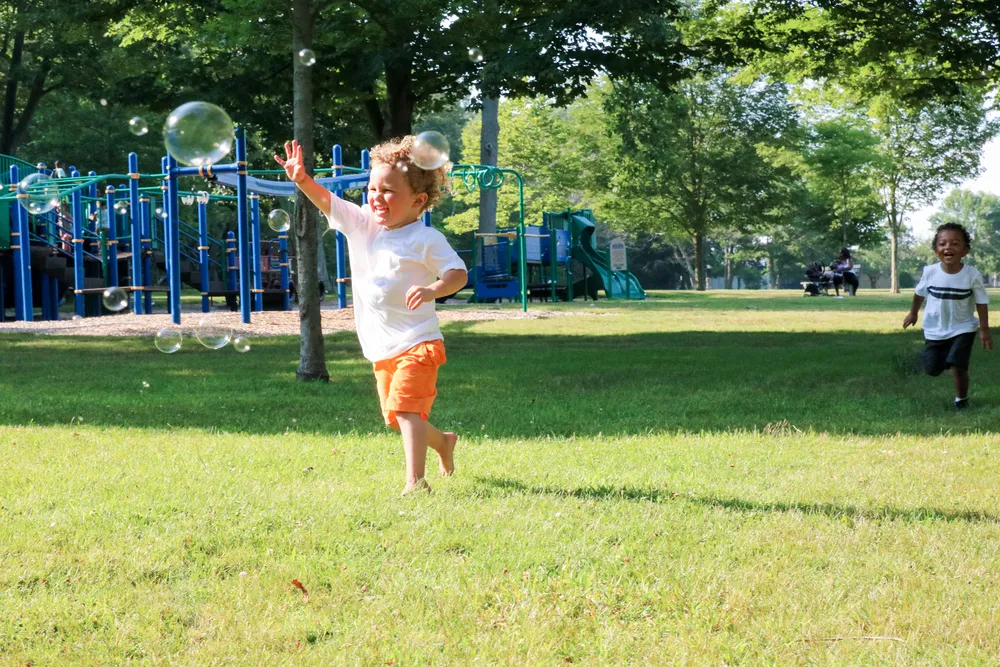
Bubbles can turn a small grassy area into an active play space within seconds. The adult blows bubbles while the child walks, reaches, turns, or runs to pop them. When the bubbles stop, everyone freezes.
Toddlers may enjoy standing in one place and reaching for nearby bubbles. Preschoolers can move between two visible markers, pop bubbles with an elbow or knee, or freeze in a funny pose.
Keep each round short so the game remains enjoyable rather than tiring. Bubble chase can help children practice visual tracking, balance, direction changes, and stopping when they hear a cue.
This activity also works well for children who are not interested in games with several instructions or competitive rules.
Play on dry, level grass instead of slippery pavement. An adult should hold the wand and bubble container, use child-safe bubble solution as directed, and prevent children from drinking or spilling it. Stop the game if the ground becomes slippery or your child begins moving beyond the safe boundary.
3. Animal-Movement Trail
Place three or four cones, chalk marks, or other large visible markers in a short line. Assign an animal movement to each part of the trail.
Children might:
- Stomp like an elephant
- Tiptoe like a cat
- Stretch like a giraffe
- Waddle like a duck
- Crawl slowly like a turtle
For younger children, demonstrate one movement and invite them to copy it. Preschoolers can follow a short sequence or choose the next animal for everyone to imitate.
There is no need to correct exactly how a child moves like an animal. The purpose is to encourage varied movement, imagination, language, and enjoyment.
An animal trail can help children practice coordination, balance, body awareness, and simple sequencing. It can also be adjusted when siblings or friends have different abilities.
Keep the trail flat and low. Skip hopping, jumping, or standing on one foot if your child is not ready. Never use benches, walls, unstable objects, or elevated playground equipment as homemade obstacles.
4. Roll, Chase, and Score
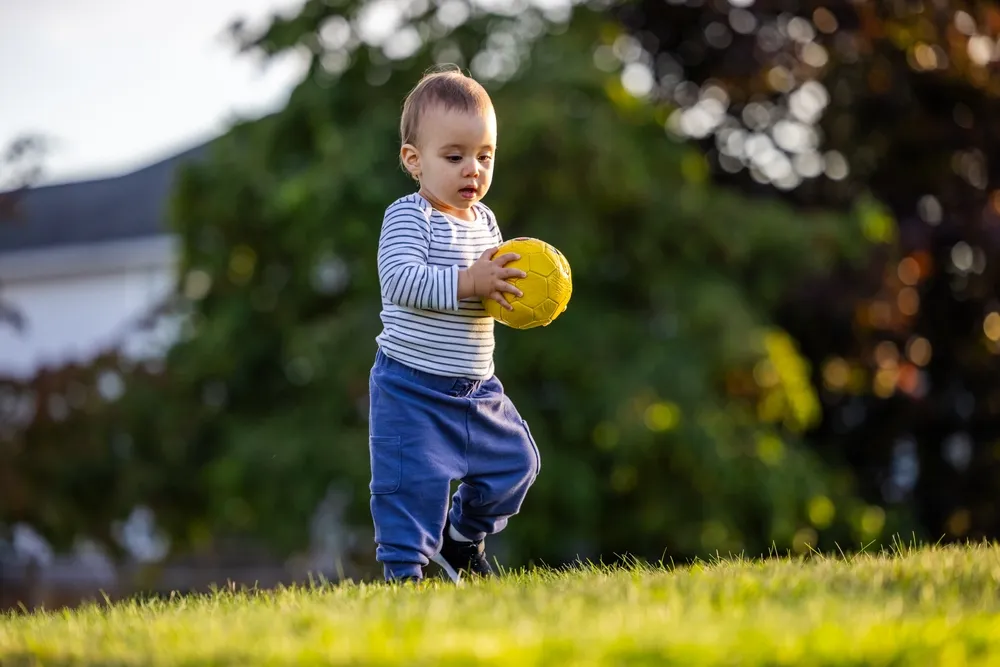
Place two large markers a few feet apart to create a goal. Roll a soft ball toward the goal, retrieve it together, and take turns. Once your child understands the game, try a gentle kick or move the goal slightly farther away.
A new walker can sit or stand close to an adult and roll the ball back and forth. Children ages 3 to 5 may enjoy taking turns as the roller, kicker, retriever, or goalkeeper.
Use simple movement words during the game:
“Ready, set, roll.”
“The ball is moving slowly.”
“Can you kick it toward the goal?”
“The ball stopped near the marker.”
Ball play helps children practice visual tracking, coordination, turn-taking, and social communication. If your child enjoys this activity, DeeCyDa’s guide to learning activities for toddlers offers additional ways to combine movement with language and responsive interaction.
Use a large, lightweight, soft ball and choose an open area away from traffic, water, dogs, swings, and other children’s games. Position the goal so a missed ball cannot roll toward a street, parking lot, or bicycle lane.
5. Chalk Move-and-Follow Path
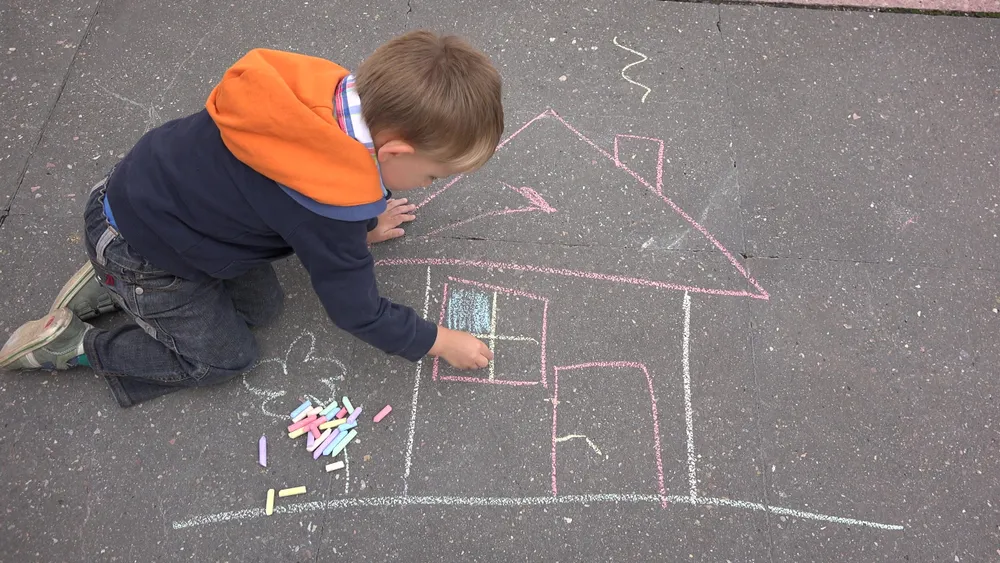
On a private driveway, patio, or permitted flat surface, draw a short path using a straight line, wide circles, large footprints, and a visible finish point.
Ask your child to walk along the line, step inside each circle, follow the footprints, and finish with a clap or stretch.
For toddlers, use only two or three large shapes and walk beside them. Preschoolers can help design the path, choose a movement for each shape, or follow a short sequence such as walk, step, turn, and clap.
A chalk path can support balance, listening, early sequencing, and creative decision-making. Because the course can be changed quickly, parents can simplify it when a child becomes frustrated or add one manageable challenge when the child is ready.
Use washable, non-toxic sidewalk chalk intended for children. Keep the path away from streets, shared parking areas, pools, sloped driveways, and busy greenbelt lanes. Check that the surface is cool, dry, and free from cracks or debris.
How to Keep Active Play Child-Led
The adult’s role is not to make each round harder. It is to prepare a safe environment, observe the child’s response, and provide the right amount of support.
If a toddler wants to roll the same ball ten times, repetition is part of learning. If a preschooler changes the animal trail into a pretend safari, follow their idea. If a child wants to watch before joining, give them time.
An activity does not need to look complicated to be meaningful.
Try describing what your child is doing instead of continually testing them:
“You stopped when the bubbles stopped.”
“You found a smooth path for the ball.”
“You took careful steps inside the circles.”
Offer two manageable choices, such as, “Would you like the bubble game or the ball game?” End the activity when your child appears tired, overheated, uncomfortable, frustrated, or no longer interested.
Parents looking for more age-specific support can explore DeeCyDa’s Caterpillar Program for toddlers, Butterfly Program for preschoolers, and approach to early childhood learning in Irvine.
Frequently Asked Questions
What are safe active plays for kids under 6?
Appropriate active games use simple rules, large and age-appropriate materials, a flat and clearly defined space, and close adult supervision. Color hunts, bubble games, animal movements, soft-ball rolling, and low chalk paths can all be adjusted to a child’s abilities.
How long should outdoor active play last?
There is no required length for one game. Young children often do best with several short periods of movement throughout the day. Follow your child’s energy, interest, comfort, and developmental readiness instead of forcing an activity to continue.
What is the best time for outdoor play in Irvine?
Cooler mornings and later afternoons are often more comfortable than midday, especially during warmer months. Check the heat, UV level, and air-quality conditions before going outside. Choose shade when possible and stop if your child shows signs of discomfort.
Can children of different ages play together?
Yes. Give each child a version that matches their abilities. One child might walk while another marches. A toddler might roll the ball from nearby while an older preschooler kicks from farther away. Do not expect the younger child to keep up with an older sibling.
What if my child does not want to participate?
Watching can be a valuable first step. Demonstrate one movement, offer a simple choice, and allow your child to join without pressure. If your child consistently avoids movement, appears to experience pain, or you have concerns about development, speak with your pediatrician.
Simple Play Can Create a More Active Day
For Irvine families, outdoor activity does not have to become a major outing. One safe patch of grass, one soft ball, and ten connected minutes can give a child room to move, observe, imagine, and practice doing something independently.
Begin with the easiest version. Keep the boundaries clear. Let your child repeat the movements they enjoy, and introduce another challenge only when they are ready.
Looking for an Irvine childcare environment that combines play, movement, social connection, and age-appropriate learning? Contact DeeCyDa to learn about its programs for toddlers and preschoolers in Irvine.
This article provides general educational information and is not a substitute for advice from your child’s pediatrician or another qualified professional.